





Azerbaijan Real Estate Market 2026 | Buy Property in Azerbaijan
Baku Luxury Real Estate & Sea Breeze Property Investment
Baku impressed me, not just as a tourist, but as someone who studies cities and real estate. The skyline, the waterfront, the architecture, and ambition—it feels alive. It feels modern, and it even reminded me of early Dubai, with obviously more heritage.
But here's the real question: Does it have the fundamentals to become a property investment hub like Dubai? Or is this just another overhyped emerging market story?
Let's break it down properly.
As investors, we need to position ourselves earlier and visualize those grand ambitions before anyone else. That's why today we're looking at Baku, Azerbaijan.
I visited Baku and I was genuinely impressed. The architecture is stunning. You have the Flame Towers, the Heydar Aliyev Center designed by Zaha Hadid, and a mix of an ultra-modern skyline with UNESCO sites, a very wide boulevard, and a very nice promenade on the marina.
It felt really safe, very culturally rich, orderly, and ambitious—very Dubai-like in its vision. The food is incredible. The people are so welcoming. The city feels secure, stable, and honestly, the residents felt like they had some financial stability.
But tourism impressions don't equal investment fundamentals. That's why I went deeper into it and tried to analyze what's going on there and how to position myself and anyone else better.
We'll start with a macro overview of Baku and Azerbaijan as a whole.
The first thing to note is that Azerbaijan is a resource-driven economy. According to World Bank and IMF data, oil and gas still account for significant exports. GDP growth has been steady, but cyclical due to price fluctuations in energy. The government has been investing significantly in diversification.
Baku itself, with a population of roughly 2.3 million, is the capital and the economic center of the whole country. Most importantly, it has a very strategic location between Europe and Central Asia, strong—very strong—ties with Turkey, and increasing regional influence.
Infrastructure investment has been going on since 2012, when Eurovision took place in Baku and the Formula 1 expansion began, which now also happens in Baku. The government has pushed modernization aggressively over the past 15 years.
Now, if we look at the property market snapshot in Baku, the first thing that we note is that the market has been very heavy on end users. There's less international speculation than in Dubai, and it's more fragmented in terms of developer quality.
If we look at the average pricing based on various Azerbaijani websites that I checked, prime Baku city apartments usually range between $1,200 and $2,500 per square meter. Compared to Dubai prime, which easily exceeds $4,000 to even $6,000 per square meter, that pricing delta immediately attracts investors.
But lower prices don't necessarily equal a better investment. We must evaluate the liquidity in this market, rental yields, exit demand—which is very important—a key, key factor in analyzing Baku specifically.
And, of course, the legal framework. You want to be secure as a global international investor. So let's start with that.
First of all, foreigners can purchase properties in Azerbaijan. If this wouldn't be true, we wouldn't be speaking right now. However, land ownership, like in many CIS countries, is restricted in some areas. Structures are generally allowed, but due diligence is critical. Title verification must be extremely thorough.
Unlike Dubai's fully transparent DLD system nowadays, Azerbaijan's registry system is less digitized and, of course, less standardized. That sequentially increases the legal risk, documentation complexity, and the need for local legal support.
This is not really a click-and-buy environment, even compared to its neighbor, Georgia, which is much easier and much more streamlined.
So overall, it is possible. There are plenty of opportunities. The developments are beautiful—literally stunning.
There is a reason why they call Baku the Paris of the East, not just because of the architecture done by the Rothschilds and everyone who was involved in the discovery of oil there, but also because of the new developments.
So, with that, let me speak about some specific projects that I was considering.
First, I'll start with a project that is actually outside the capital, but very close by. And this is called Sea Breeze Resort.
Now, this is where things get interesting.
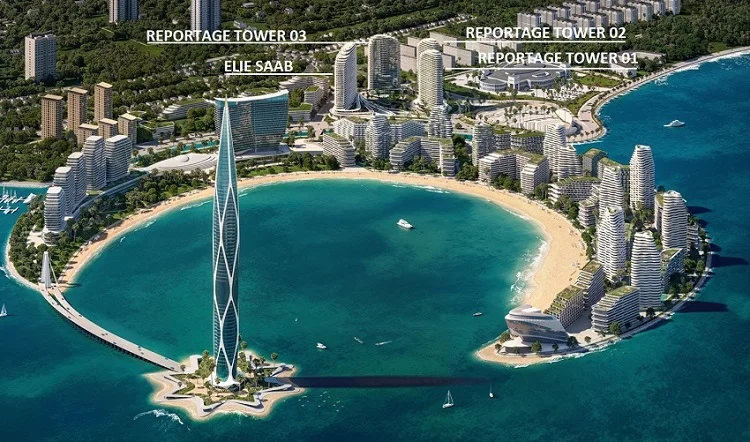
Just outside Baku, as I mentioned, along the Caspian coast, you have the Sea Breeze Resort, developed by Emin Agalarov.
For context, if you don't know, Emin is the son of Aras Agalarov, who is one of the largest property developers in the whole post-Soviet region. He's the founder of the Crocus Group and one of Russia's largest development companies.
But today, we don't speak about that. We're focusing on his son's developments, specifically in Baku.
So, Sea Breeze is positioned as a very large-scale coastal master developer. It's a lifestyle resort community, including everything you can imagine—from villas and townhouses to apartments with all kinds of views, golf-side properties, and more.
Moreover, it's mixed residential, hospitality, and entertainment. It sounds a bit like Dubai and some of the master communities that Emaar specifically develops.
They've built branded residences, beach clubs, mid-rise coastal buildings, and private villas. Visually, it looks like a Mediterranean—or even a European Dubai—version of a coastal ambition.
Their marketing suggests a very long-term vision of turning Sea Breeze Resort into a full-scale coastal destination city.
So, it's actually a completely new city within the country. And honestly, visually, it's hyper-impressive.
They have plenty of flagship projects, which I'll mention quickly, that really blew my mind.
But again, as investors, vision must meet the fundamentals. So, let's look into that.
Speaking about the flagship projects, let's mention some of them. As I already mentioned, Sea Breeze includes luxury low-rise apartments. When I watched some interviews with Emin, he mentioned that they were not really allowed to build anything higher than four or five floors. But then, when he presented the whole master plan to the government, they agreed to allow this to happen.
So now, besides the private villa communities, you might see higher towers and taller buildings. However, everything is done in harmony with each other, and every single community works really well together, even though they're so, so different.
If you check some reviews, even on YouTube, you'll see everything from forest-looking areas to very beachside, Mediterranean-type villas. It's really interesting because you can choose anything in between. You even have golf carts to get around.
Pricing can, of course, vary depending on the development phase. Some offerings appear significantly below Dubai alternatives, but it's important to note that liquidity is also thinner. The international buyer base is much smaller than in the UAE, and the exit market is also regional. It's more focused on Turkey and the post-Soviet countries. However, from the research I've done, they are still attracting many Western investors, and I think that number is growing. They still don't have the same kind of hype as we had in the UAE.
So, this is not yet a global liquidity asset market like Dubai Marina or Palm Jumeirah, but it definitely has that potential.
Besides the capital appreciation, which many reviews and interviews I've watched mention—not only from the developers themselves but also from people who actually invested there—you can research YouTube and you'll find many examples. They usually mention that, by the time of completion, they achieved about 30% to even 40% capital appreciation, which is quite impressive.
But what if you don't want to flip it? What if you just want steady income?
That's why we need to look at the rental market and see if there is any viable opportunity.
If we look specifically at Baku rental yields, reported estimates suggest something between 5% and 8% gross rental yields, depending on the location. However, seasonality is a big factor. Tourism demand is rising, but it's not yet at mass scale. Short-term rental demand also exists, but it's nowhere near Dubai's volumes.
The hotels there are actually quite affordable, and there are plenty of options. Population growth is also slower, and the expat base is definitely much smaller than in Dubai. This means less rental velocity and a more localized tenant pool.
However, while watching some interviews with Emin, he mentioned that over the last few years there has been a very interesting shift happening specifically in Sea Breeze Resort. Many residents have gradually become full-time residents, spending most of their time in that city and simply driving to Baku. He mentioned something around 40% to 50%, although I'm not sure whether I fully believe that figure. Maybe it's a bit lower, but it's still a very interesting point.
So, why are investors currently looking at Baku, besides my own personal interest?
Some reasons include the relatively undervalued prices compared to Dubai, the lower entry ticket compared to many other well-developed countries around Azerbaijan, and the fact that, while many people say this is still a developing country, you simply need to visit Baku to understand what I mean. It's a very, very developed city.
Early-stage master-planned developments, regional diversification, and emotional appeal all make it quite attractive. It's a beautiful city.
Psychologically, investors also love the "next Dubai" narrative, and some developers in Baku are trying to position their projects that way. However, the term "next Dubai" is often used too loosely.
Dubai had aggressive freehold reforms, strong capital inflows driven by tax advantages, global branding, and extremely deep liquidity. The registry system became ultra-transparent, and everyone worked toward that goal.
Baku is earlier in this evolution, but it could definitely reach that point if the government continues pushing in that direction.
Now, let's talk about the risks.
The first is liquidity risk. For me, as an international investor, this is extremely important. The resale market is much less liquid compared to the UAE. If I invest, I want to know that I'll be able to sell the property without competing against countless other developers and units in the same area.
This is something I'll definitely continue monitoring over the coming months and years before making an investment.
The second risk is regulatory transparency. The legal framework is less streamlined compared to Dubai's DLD system. I'd want to consult experienced legal professionals to fully understand how everything works, what the potential caveats are, and where additional risks may exist, so I can properly factor them into my investment decision.
Economic concentration is another important factor because the country still relies heavily on the energy sector. While I don't see this as the biggest threat, it remains an important macroeconomic consideration. If energy prices fluctuate significantly, construction costs and the broader economy could also be affected.
Currency risk is another important consideration. The Azerbaijani manat introduces additional currency exposure. While it has appeared relatively stable, anyone investing long-term should consider the potential impact of future exchange-rate movements. This applies to any international investment outside major currencies such as the euro or the U.S. dollar. Looking at historical currency trends over the past 20 to 30 years is definitely worthwhile.
Another factor is the limited global buyer base. Demand remains much more regional than international. If market conditions change, you may find yourself selling primarily to local or regional buyers, which naturally limits liquidity and may create additional pricing pressure.
Finally, there's developer quality. Not every developer operates at institutional standards. That's exactly why I highlighted Sea Breeze Resort. I know their background. I've followed Emin's father for many years and have seen what he has built across the post-Soviet region. It's genuinely impressive.
That's one of the reasons I consider this an interesting project. He's also actively presenting projects in Dubai and other international markets to high-level investors. He has even partnered with Donald Trump on previous projects.
That said, if you're considering other regional developers or smaller projects in Baku, you should perform significantly deeper due diligence.
Now, to wrap everything up with my personal opinion and positioning on this market.
I see Baku as a very promising regional destination. It's a lifestyle market with significant upside if current trends continue. It's also a market that has been on my investment radar for years.
Initially, I was considering both Georgia and Azerbaijan. I chose Georgia for my first investment in this region, but Azerbaijan is next.
Sea Breeze, in particular, is an ambitious project, and if you check it out, you'll see just how many impressive developments they have planned.
Uh, they even planned a project that looks like the Titanic on the sea. It's like a big boat, but it hosts apartments and so on. It's really cool, so just check it out.
But this is not a buy-blindly environment. You need to do your due diligence, have all the legal checks done, verify the title structure, assess the development quality, and plan your exit before you buy. That's so critical.
So, in conclusion, I see Baku as a very prospective destination in the region, but also for the world.
1. Is Baku becoming the next Dubai?
Baku has many similarities with early Dubai: ambitious urban development, modern architecture, a growing skyline, luxury projects, and a strategic location between Europe and Asia. However, Baku is still developing its international business ecosystem and has not yet reached Dubai’s level of global connectivity.
2. Is buying property in Baku a good investment?
Baku can be an attractive investment opportunity, especially for investors looking at emerging markets. Property prices are generally lower than in major global hubs, while the city continues to improve its infrastructure, tourism appeal, and business environment.
3. What areas of Baku have the highest investment potential?
Areas near the Caspian Sea, central districts, modern residential complexes, and locations connected to major infrastructure projects generally attract more investor interest. Waterfront development and premium neighborhoods may have stronger long-term potential.
4. Can foreigners buy property in Baku?
Yes, foreigners can purchase real estate in Azerbaijan. However, ownership rules, taxes, and residency benefits depend on individual circumstances and should be checked with official authorities or legal advisors.
5. Does buying property in Azerbaijan provide residency?
Property ownership alone does not automatically guarantee residency. However, under certain conditions, real estate investment may support applications for temporary residence permits.
6. Are property prices in Baku cheaper than Dubai?
Generally, Baku property prices are significantly lower than Dubai’s prime real estate market. This creates potential upside if the city continues attracting international businesses, tourists, and investors.
7. What are the risks of investing in Baku real estate?
Like any emerging market, Baku has risks, including market fluctuations, currency considerations, limited liquidity compared with global cities, and dependence on economic diversification beyond oil and gas.
8. Why are investors interested in Baku?
Investors are attracted by:
- Strategic location between Europe and Asia
- Modern infrastructure
- Growing tourism sector
- Lower entry prices compared with global cities
- Government focus on urban development
9. Can Baku attract international companies like Dubai?
Baku has the potential to attract more international companies, but it needs continued growth in areas such as finance, technology, logistics, and global business services to compete with Dubai.
10. Is now a good time to invest in Baku real estate?
For investors seeking emerging-market opportunities, Baku may offer attractive entry points. However, investment decisions should be based on location, property quality, market research, and long-term goals.
11. Will Baku property prices increase in the future?
No market can guarantee future growth, but factors such as infrastructure development, tourism growth, foreign investment, and economic diversification could support long-term appreciation.
12. What makes Baku different from other emerging cities?
Unlike many newly developed cities, Baku combines modern urban development with centuries of history, cultural heritage, and a unique coastal location on the Caspian Sea. This combination gives it a distinct identity and tourism appeal.
Related

We will arrange a meeting with a World Immigration Hub specialist for you in person or online format
During the meeting, the specialist will:
- Explain how we work and how we can help you.
- Explain the immigration process step-by-step, presenting the roadmap, budget, and financial requirements.
- Share our immigration experience and discuss key points you should know before starting your journey.
- Determine the next steps together with you.
Depending on the project’s complexity, the meeting with the manager may be coordinated with experts, designers, and assistants.

Natalia Kovalenko
Immigration Consultant

Mehman Asadzade
Immigration Lawyer